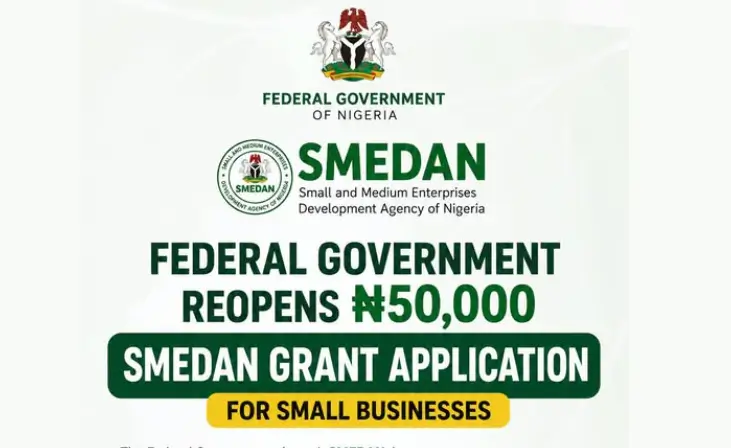
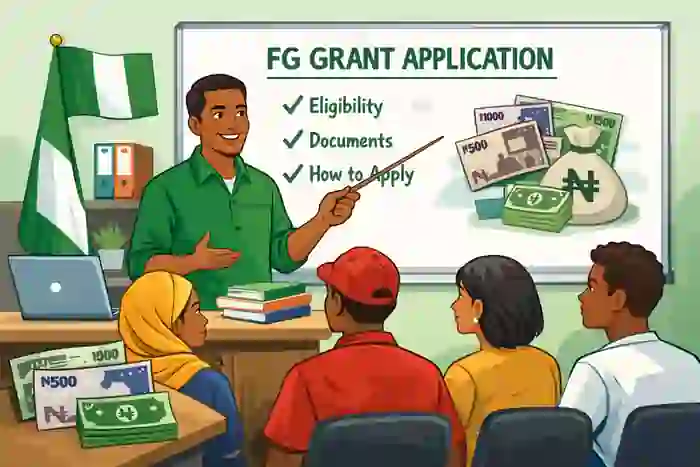
Thinking of submitting an FG Grant Application in 2026 but you’re not sure how to start? You’re not alone at all. With different application portals, changing requirements, and plenty of fake “agents” online, applying for a Federal Government (FG) grant in Nigeria can be confusing and even risky.
This guide breaks the FG Grant Application process down in simple terms—showing you what FG grants are, where to apply, how to apply the right way, how beneficiaries are selected, what happens after approval, and how to avoid common mistakes or scams.
If you follow this guide step by step, you’ll understand the entire FG grant journey—from discovery to disbursement and post-grant compliance.
What Is an FG Grant?
An FG grant is financial support provided by the Federal Government of Nigeria to individuals, businesses, cooperatives, and organizations to achieve national development goals. Unlike loans, most grants are non-repayable, but they are conditional—meaning the funds must be used strictly for the approved purpose.
FG grants are used to support:
- Small businesses and traders
- Youth and women empowerment
- Agriculture and food production
- Manufacturing and SMEs
- Innovation, technology, and creative industries
- Job creation and poverty reduction
Some grants like the S-VCG, Presidential Conditional Grant Scheme (PCGS), the Presidential Palliative Grant, the National Social Investment Programme (NSIP) grants, and the Student Loan and Education Support Grants, etc. are implemented directly by ministries like the Federal Ministry of Industry, Trade and Investment, Federal Ministry of Agriculture and Food Security, Federal Ministry of Education, and the Federal Ministry of Humanitarian Affairs and Poverty Reduction, etc. while others are managed through agencies and development institutions such as the Bank of Industry (BOI).
All legitimate FG grants are backed by the Federal Government of Nigeria.
Who Can Apply for FG Grants in 2026?
One common misunderstanding is that FG grants are only for “big companies” or people with connections. In reality, most FG grants in 2026 are designed for ordinary Nigerians—especially small business owners, traders, youths, farmers, and cooperatives.
That said, not every grant is for everybody. Each programme targets a specific group, and knowing where you belong makes a big difference.
1. Small business owners, traders, and artisans
If you run a small shop, kiosk, roadside business, workshop, or home-based business, you are actually one of the main targets of FG grants.
Examples include:
- Presidential Conditional Grant Scheme (PCGS) for petty traders and nano businesses
- Presidential Palliative Grants for small-scale traders affected by economic hardship
These types of grants often:
- Do not require CAC registration
- Focus more on proof of business activity
- Are common among market men and women, tailors, hairdressers, mechanics, food vendors, and phone repairers
If you hear people say “this grant is for market people,” this is what they mean.
2. Startups and registered SMEs
If your business is registered with CAC (Business Name or Limited Liability Company), you qualify for a wider range of FG grants.
These grants usually support:
- Business expansion
- Equipment purchase
- Production and manufacturing
- Job creation
Examples include:
- SME support grants under government empowerment programmes like the MSME Survival Fund, SMEDAN–linked empowerment grants, Presidential Palliative SME Support, etc.
- Sector-based grants for manufacturing, tech, creative industry, and services are targeted FG interventions meant to support specific industries that drive growth and employment.
- Examples include manufacturing support and industrial grants for small factories and processors, technology and innovation grants for startups and digital businesses, creative industry grants for filmmakers, musicians, fashion designers, and content creators, and service-sector support programmes for logistics, hospitality, healthcare, and professional services.
- These grants are usually competitive and focus on scalability, innovation, local content, and job creation, making them ideal for businesses that are already operating and ready to grow.
Here, government looks closely at:
- Your CAC documents
- Bank account in the business name
- How many people you employ or plan to employ
3. Youths and young Nigerians
Many FG grants in 2026 are youth-focused, especially for Nigerians between 18 and 40 years old. Examples include:
- Youth Economic Intervention and De-Radicalisation Programme (YEIDEP): A federal scheme offering grants (often between about ₦50,000 and ₦500,000), training, and mentorship to young entrepreneurs with viable business ideas.
- Federal Government Youth Empowerment Initiative for Climate Action 2026: This is an ongoing programme that supports young Nigerians to develop climate-responsive businesses and skills, part of broader youth empowerment efforts for 2026.
- Circular Economy Youth Empowerment Initiative (CEYEI): Launched to help youth engage in waste-to-wealth and other sustainability projects, often with training and seed support (part of broader youth policy actions).
- Nigeria Youth Futures Fund (NYFF) – Leadership Development Grants: Though the current cycle reference is up to 2025, this fund continues to support youth leadership and ecosystem building and is often cited as part of youth grant trends.
These programmes often combine cash support or seed funding, training, and mentorship, and are aimed at turning ideas into sustainable ventures — not just handing out money. They reflect the Federal Government’s recent focus on economic inclusion, skills development, climate innovation, and enterprise growth for young Nigerians in 2026.
These programmes often target:
- NYSC members or graduates
- Unemployed or underemployed youths
- Young people with skills (ICT, fashion, media, agriculture, trades)
Some youth grants may not pay cash directly but provide:
- Monthly stipends
- Tools and equipment
- Training and certification
4. Farmers and agro-business operators
If you’re into farming—crop production, livestock, poultry, fishery, or agro-processing—you are a major target of FG grants.
These grants may support:
- Seeds and inputs
- Farm expansion
- Processing equipment
- Cooperative farming
Examples include:
- Agriculture intervention grants
- Food security and farmer support programmes
Many of these grants prefer:
- Farmer groups or cooperatives
- Evidence of land or farming activity
- Simple records of production
5. Women-focused applicants
Some FG grants are specifically reserved for women, while others give women priority consideration.
Women-targeted programmes include:
- The Nigeria for Women Project (NFWP) Grant 2026
- Women empowerment grants
- Trader and micro-business grants with women quotas
These are common among:
- Market women
- Women-owned SMEs
- Home-based business owners
In many cases, being a woman already improves your chances—if you meet the basic requirements.
6. Cooperatives, associations, and groups
FG grants often favour groups over individuals, especially for agriculture, manufacturing, and community projects.
Eligible groups include:
- Registered cooperatives
- Trade associations
- Farmer groups
- Women or youth collectives
Why government likes cooperatives:
- Easier monitoring
- Broader impact
- Shared responsibility
Some grants are only accessible through cooperatives.
7. Who is usually NOT eligible
It’s important to be realistic. Most FG grants do not favour:
- Senior civil servants (unless stated otherwise)
- Applicants submitting fake or inconsistent documents
- People applying without meeting basic criteria
- Applicants trying to use agents to “force approval”
Also, many grants do not allow multiple benefits at the same time.
The bottom line
If you are:
- Running a small business
- Trading in a market
- A youth with skills
- A farmer
- A woman entrepreneur
- Or part of a cooperative
There is likely an FG grant meant for you in 2026.
The key is applying for the right programme, through the correct portal, with accurate information.
Eligibility depends on the specific program, but FG grants generally target:
- Small business owners
- Traders and artisans
- Startups and SMEs
- Farmers and agro-processors
- Youths and women
- Cooperatives and associations
Some grants accept informal businesses, while others require CAC registration, TIN, and bank verification. Always read eligibility rules carefully before applying.
Official FG Grant Application Portals (Where Nigerians Apply)
One of the biggest mistakes applicants make is assuming there is one central FG grant website. In reality, FG grants are hosted on multiple official portals, depending on the program.
Types of official portals
- Federal ministry portals
- Agency-managed portals
- Development finance portals (e.g. BOI-linked schemes)
- Special presidential intervention portals
Important: There is no official FG grant that requires payment to “agents” or middlemen for access.
Before You Apply: Critical Preparation Stage
Successful applicants prepare before any portal opens.
1. Define your purpose
Know exactly what the grant will be used for:
- Equipment purchase
- Working capital
- Expansion
- Training
- Production support
Your purpose must align with the grant’s objective.
2. Confirm eligibility
Check:
- Business type
- Registration requirements
- Location (state/LGA focus)
- Target group (youth, women, sector)
3. Prepare essential documents
Have these ready before applying:
- Valid ID (NIN slip, passport, driver’s license)
- CAC registration (if required)
- Bank account + BVN
- TIN (active)
- Proof of business activity
- Passport photograph
How FG Grant Application Portals Work (Step-by-Step)
Most FG grants require you to apply through specific online platforms rather than a single universal system. A good place to start is this FG Grant and Loan Portal 2026 guide, which outlines the actual portals used for real applications and helps you confirm legitimacy before submitting your document and data Most FG grants follow this online process:
Step 1: Account registration
- Create an account with email and phone number
- Verify via email or OTP
Step 2: Bio-data & business details
- Personal information
- Business name and address
- CAC number (if applicable)
Step 3: Bank & identity verification
- BVN validation
- Bank account confirmation
Step 4: Document upload
- PDF or JPG format (usually under size limits)
- Clear and readable scans
Step 5: Project or usage details
- What the money will be used for
- Expected outcomes (jobs, growth, output)
Step 6: Final submission
- Review everything
- Submit and save confirmation/reference number
By following this flow and ensuring you use the correct portal as explained in resources like the linked FG Grant and Loan Portal 2026 guide, you can reduce errors and improve your chances of success.
Writing a Winning FG Grant Proposal (Simple but Effective)
Most FG grants require either:
- Short answers on the portal, or
- A 1–3 page proposal
Winning structure:
- Summary – who you are and what you do
- Problem – what challenge you’re solving
- Solution – how the grant helps
- Budget – clear, realistic figures
- Impact – jobs, production, income
- Sustainability – what happens after the grant
Avoid exaggeration. FG verification is real.
Common Documents That Cause Disqualification
Many applicants fail silently because of these issues:
- CAC name does not match bank account
- Inactive or unlinked TIN
- BVN phone number no longer active
- Business category mismatch
- Fake or reused documents
- Inconsistent information across forms
Double-check everything.
How FG Grant Beneficiaries Are Selected
FG grants are not random.
Selection involves:
- Automated eligibility screening
- Document verification
- Scoring based on impact
- State/LGA balancing
- Budget limitations
Priority is often given to:
- Women and youth
- First-time beneficiaries
- Businesses with employment potential
What Happens After You’re Selected?
1. Approval notification
- Email or SMS
- Instructions to accept grant
2. Grant agreement
You may be required to:
- Sign terms and conditions
- Accept monitoring rules
- Agree to fund usage limits
3. Disbursement
- Paid into verified bank account
- Sometimes in tranches
Managing FG Grant Funds Properly
Once funds are received:
- Use money strictly for approved purpose
- Keep receipts and invoices
- Document progress with photos
- Submit required reports
Misuse can lead to:
- Fund recovery
- Disqualification from future grants
- Blacklisting
FG Grant Scams to Avoid in 2026
Avoid:
- WhatsApp “agents” asking for fees
- Requests for OTP or ATM details
- Facebook pages promising guaranteed approval
- Requests for BVN login
FG grants do not require payment to apply.
Reapplying and Multiple FG Grants
- Some grants allow one-time benefit only
- Others allow reapplication after a waiting period
- Multiple grants at once are usually not allowed
Always check program rules.
FAQs
Can NYSC members apply?
Some youth-focused grants allow it.
Can civil servants apply?
Usually no, unless stated.
Can I apply without CAC?
Yes, for nano or trader grants only.
Can cooperatives apply?
Yes, many FG grants prefer cooperatives.
FG Grant Application Timeline (Typical)
- Announcement → Deadline: 2–6 weeks
- Screening: 2–4 weeks
- Verification/interviews: 1–4 weeks
- Approval & disbursement: up to 6 weeks
Final FG Grant Application Checklist
- Eligibility confirmed
- Documents ready and accurate
- Proposal clear and realistic
- Correct portal used
- Submission confirmation saved
Final Words
FG grants in 2026 remain one of the best non-repayable funding opportunities for Nigerians—but only for those who apply correctly, early, and honestly. Preparation and accuracy matter more than connections.
For verified updates, live application portals, and step-by-step breakdowns of ongoing FG grants, always check fggrantloan.ng and bookmark this guide for future reference.